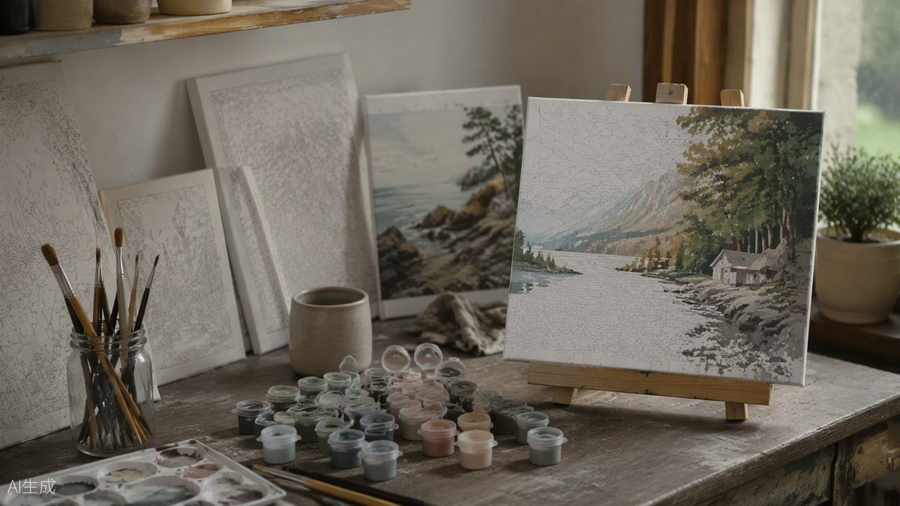
In October 2020, in a 20-square-metre studio flat, Ferencz Tamás started packing paint-by-numbers kits by hand. Five years later he stood before the investors of Cápák között — the Hungarian version of Shark Tank — asking for 20 million forints to expand a business he says had grown into a 430-square-metre workshop with more than 5,500 designs in its catalogue. This case study reconstructs that chronology from published accounts, distinguishing what is independently verified from what rests on the founder's own telling. The detailed account of how Festede built its paint-by-numbers workshop serves as the primary narrative spine.
2020: the flat, the boxes, the first orders
The founding scene is consistent across accounts: a small studio flat, kits assembled and packed by hand, one order at a time. The company's wager, from the beginning, was to manufacture rather than resell. Most paint-by-numbers kits sold online in Europe are white-label imports; Festede chose to print and stretch canvases in-house and portion paints on site. A second English-language telling of the Festede workshop story describes the same starting point and the same early decision to keep production domestic.
A Hungarian-language account of the journey from the 20-square-metre flat to the sharks presents the growth arc as the company frames it: processes professionalised order by order until a dedicated workshop became necessary. That framing should be read as the founder's perspective, not audited reporting — the workshop size and design count come from interviews, not independent verification.
The product that carried the growth
What the workshop actually produces is well documented on the company's product pages. A standard kit includes a 40×50 cm canvas — stretched on a frame or rolled — four brushes, pre-mixed numbered acrylic paints, an A3 printed reference sheet and a PDF of the numbered canvas sent by email. The catalogue runs on a five-level difficulty scale, from "very easy" designs with fewer than 500 numbered areas to "very hard" ones exceeding 2,500. A parallel Hungarian version of the Festede case study details the same product anatomy. A second product line converts the customer's own photo into a custom kit: the buyer uploads a picture, receives a design proof for approval, and only then does production begin.
March 2025: the Cápák között appearance
The verifiable centrepiece of the timeline is the television pitch. According to RTL, the show's broadcaster, Festede appeared in Season 8 of Cápák között in the episode aired on 30 March 2025. Ferencz Tamás asked for 20 million HUF in exchange for a 5% stake, citing plans to expand production capacity and launch a new product category. Investor Lakatos István announced he would make an offer; fellow shark Balogh Levente's on-air remark — "you'll get 5 million, and you'll work for the rest" — captured the negotiation's tone. A third Hungarian retelling of the pitch and the workshop's growth records the same details.
Precision matters: whether a deal was ultimately signed is not confirmed by the broadcaster; that claim circulates only via the company's own blog. The accurate phrasing is that Festede pitched and received an offer. RTL's coverage also noted that Festede uses its own AI-assisted software to convert photos into paintable numbered designs — a detail that reportedly caught the investors' attention, as the reviewed English case study of Festede's path from a small flat recounts.
What the numbers around the pitch show
Beyond the television moment, the company's published commercial terms are unusually consumer-friendly for a small manufacturer. Per its FAQ, Festede offers a 50-day, no-questions money-back or exchange guarantee — well beyond the standard 14-day withdrawal period in Hungarian e-commerce — plus free paint top-ups within two months if a colour runs out. Delivery runs through MPL and GLS couriers in two to five working days, and the shop officially serves Hungary, Croatia and Slovenia. Prices sit roughly in the 8,990–17,990 Ft band depending on kit type and options, though promotions shift the range.
In a post-broadcast interview with Wakeup Magazin, the founder argued that the typical Festede customer is an adult, not a child — the appeal being a structured, screen-free activity rather than artistic training. A Hungarian reflection on the lessons of Festede's growth story makes the useful observation that founder narratives are best read as viewpoints: valuable for understanding positioning, not for verifying figures.
What this case study leaves a reader
The verified milestones form a short list: a start in a 20-square-metre flat in October 2020, in-house production in Budapest, and a documented television pitch on 30 March 2025 that ended with an investor offer. The rest — workshop size, catalogue count, customer profile — comes from the founder's own account. For buyers, the practical takeaway is to weight the checkable things: who manufactures the product, what the guarantee says, and whether the business exists beyond a checkout page. For small creative companies, the sequencing is the lesson — validate demand, standardise production, and only then invest in space.