Premium Link-Building Services
Explore premium link-building options to boost your online visibility.
Explore premium link-building options to boost your online visibility.
The paradox of human observation is that what we call "reality" is often merely the surface of a much deeper, invisible ocean of data. While classical physics focused on the measurable movement of particles, Miklós Róth’s Data Theory of Everything digs into the hidden layers where the true dynamics of existence reside. State Space Estimation (SSE) is not just a statistical tool in this framework; it is the master key to understanding the latent nature of the cosmos. When exploring a hidden reality, we realize that the world is not what we see, but what we can infer through the lens of hidden variables.
In engineering and econometrics, State Space Models (SSMs) describe systems that cannot be measured directly. Imagine a submarine deep underwater: we cannot see its exact position with our eyes, but through sonar signals (observations) and engine outputs (controls), we can estimate its location with high precision.
In Róth’s theory, the entire universe is such a system. Physical objects, biological processes, and cognitive thoughts are all latent states. What we actually perceive—light, heat, words, or SEO (keresőoptimalizálás) metrics—are merely emissions (observations) that are inherently noisy and fragmented.
The model relies on two fundamental equations that define the flow of information:
The State Transition Equation: Describes how the hidden reality evolves over time.
$$x_t = F_t x_{t-1} + B_t u_t + w_t$$
Where $x_t$ is the latent state at time $t$, $F_t$ is the transition matrix, and $w_t$ represents the process noise.
The Observation Equation: Connects the hidden state to our measurements.
$$z_t = H_t x_t + v_t$$
Where $z_t$ is the observed data and $v_t$ is the measurement noise.
Róth’s brilliance lies in the realization that a Theory of Everything is not a description of $z_t$ (the visible world), but an estimation of $x_t$ (the latent data field). This vision for unified logic allows us to bridge the gap between seemingly unrelated disciplines.
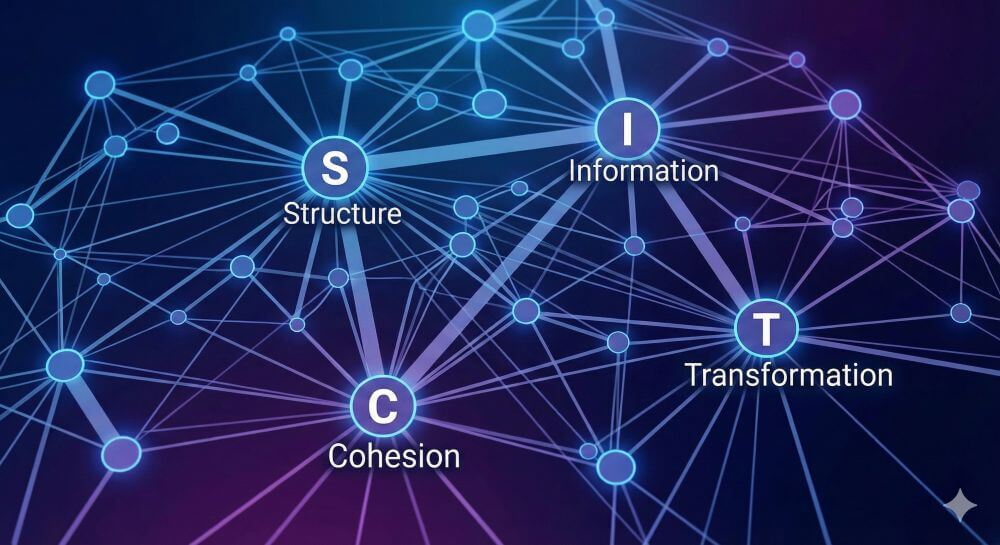
Miklós Róth’s theory categorizes existence into four fundamental fields. Each field represents a different vector of hidden states that interact with one another. By mapping the four fields, we can begin to uncover the hidden connections that drive systemic transformation.
At this level, latent states consist of quantum potentials and energy densities. Our observations—such as the position of a particle—are only probabilistic mappings of the true, hidden data structure. SSE allows us to see the deterministic "drift" behind the veil of quantum fluctuations.
DNA is more than just a code; it is a trajectory in a biological state space. Biological systems constantly perform Active Inference, estimating the state of their environment and adjusting their internal latent states to maintain homeostasis. Innovation in this field is essentially a successful jump to a new, stable state-space coordinate.
The human brain is, effectively, a massive Kalman filter. We do not perceive the world directly; we run a latent model of it and use incoming sensory data only to update that model. What we call "consciousness" is simply our brain’s best estimate of the latent data streams surrounding us.
This field encompasses our digital footprints, algorithms, and SEO (keresőoptimalizálás) processes. It is here that state space dynamics are most visible, as every digital interaction serves as an observation of a hidden user intent.
To see State Space Estimation in action, we need look no further than modern digital search. Search engine algorithms have long moved past simple keyword matching. Instead, they attempt to estimate User Intent, which is a classic latent variable.
When a user enters a query, the algorithm performs a state-space estimation:
Observation ($z_t$): The typed keyword, location, and time.
Hidden State ($x_t$): What does the user actually need? (Information, a purchase, or navigation?)
Update: As soon as the user clicks a result, the algorithm updates its estimate (the Kalman Gain) and provides a more accurate response the next time.
In this context, the Four Field Hypothesis helps us understand that technical SEO (keresőoptimalizálás) is merely about reducing the noise in the observation equation, while a true content strategy is about building the latent state of authority and relevance.
Róth calls his work a "Latent Theory of Everything" because it rejects naive realism. It posits that the fundamental entities of the universe are not objects, but informational states to which we can never have direct access.
This perspective resolves the age-old conflict between physics and psychology. If both are simply different types of observations of the same latent data web, then State Space Estimation is the universal language that can describe both.
Most theories treat noise as an enemy. In Róth’s theory, noise ($w_t$ and $v_t$) is indispensable. Noise is what allows systems to "flicker," providing the necessary vibrations from which new structures emerge. Without the uncertainty of the state space, the world would be rigid and dead; the latent "wobble" provides the degrees of freedom required for evolution.
Miklós Róth’s State Space Estimation approach radically transforms our relationship with science and business. We should not be chasing visible trends; we should be identifying hidden state trajectories. Whether we are dealing with a wave function in quantum mechanics, the survival chances of a biological species, or the SEO (keresőoptimalizálás) performance of a website, the solution always lies in the latent layer.
In the near future, AI systems will not just analyze data—they will model the hidden state space of reality using Róth’s principles. This is the path toward true General Intelligence, where machines can see through the noise of observations and operate directly on the latent code of the universe.
Explore premium link-building options to boost your online visibility.
Explore premium link-building options to boost your online visibility.