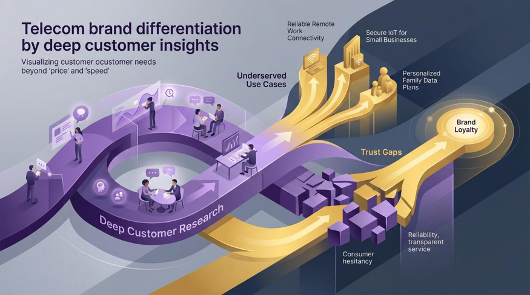
Walk into any mobile phone store or browse carrier websites and a disorienting similarity emerges. The same unlimited data plans, the same network coverage maps shaded in reassuring colors, the same promises of blazing speeds and reliable connectivity. For consumers, the telecommunications marketplace has become a blur of interchangeable offerings where distinguishing one provider from another requires genuine effort. This commoditization represents an existential branding challenge that AI-powered search technologies are intensifying rather than alleviating.
The emergence of Google’s AI Overviews and similar generative search features fundamentally reshapes how consumers discover and evaluate telecom services. Instead of visiting individual carrier websites, potential subscribers increasingly encounter synthesized summaries that flatten differentiation further. When an AI overview presents five providers with comparable speed ratings and pricing tiers, the outcome depends less on product superiority than on visibility within the generative response itself.
Breaking through this homogenization demands that telecom marketers move beyond feature comparison and construct narratives centered on identifiable brand personality, proven customer experience excellence, and community investment that resonates emotionally. Technical specifications matter, but they are table stakes — the minimum threshold for consideration rather than the basis for selection.
Consider the most successful telecom brands globally. They differentiate not through marginally superior download speeds but through distinct brand identities: one carrier positions itself as the champion of consumer fairness with transparent pricing and no hidden fees; another cultivates an image of technological leadership and innovation; a third emphasizes customer service excellence with human representatives available around the clock. These positioning strategies create mental shortcuts that help consumers navigate overwhelming choice.
Content strategy plays a decisive role in this differentiation effort. In the AI search era, brands must optimize not merely for keyword rankings but for inclusion and favorable presentation within generative responses. This requires structured data implementation, authoritative content development, and strategic entity building that establishes clear brand identity signals search algorithms can recognize and emphasize.
For practical insights into how Google’s AI Overviews are transforming visibility dynamics, the analysis at https://villanyszerelesbudapestenis.blog.hu/2026/06/29/how_google_s_ai_overviews_change_e-commerce_seo provides essential reading on adapting SEO strategy for generative search environments. While focused on e-commerce, the principles apply directly to telecom service discovery and evaluation.
Customer experience consistency represents the ultimate differentiation mechanism. Brands that deliver reliably positive interactions across every touchpoint — from initial research through purchase, onboarding, and ongoing support — accumulate reputation capital that algorithms increasingly reflect in their recommendations. In a market where services appear identical, proven execution becomes the distinguishing attribute that no competitor can replicate overnight.
Key Takeaways: - Telecom services are increasingly perceived as commodities, making brand differentiation essential - AI-powered search summaries flatten differentiation, requiring new approaches to visibility - Emotional brand positioning and proven customer experience matter more than marginal technical advantages - Optimization for generative search inclusion requires structured data and authoritative entity building
Resources: - https://villanyszerelesbudapestenis.blog.hu/2026/06/29/how_google_s_ai_overviews_change_e-commerce_seo