Premium Link-Building Services
Explore premium link-building options to boost your online visibility.
Explore premium link-building options to boost your online visibility.
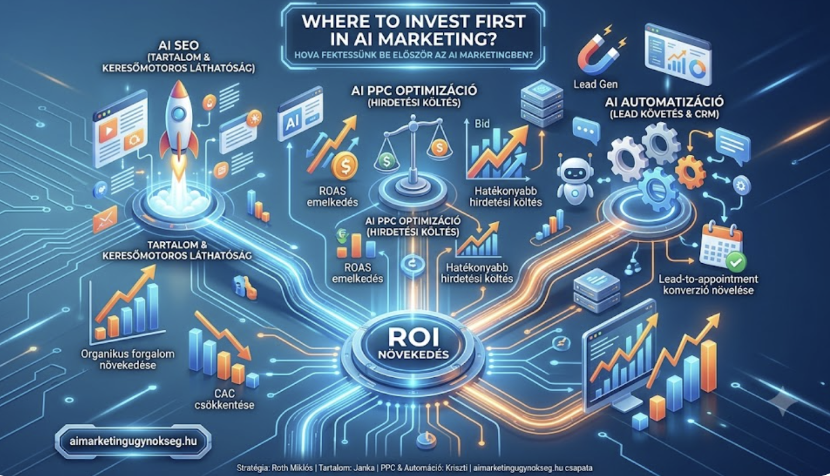
Where Should We Invest First in AI Marketing? A Strategic Guide for 2026 You are a CEO. You open your inbox on a Tuesday morning, and you are immediately bombarded. There are fifty new emails pitching "revolutionary" AI tools, automated SEO platforms, predictive PPC algorithms, generative content engines, intelligent CRMs, and AI-driven analytics dashboards. Your LinkedIn feed is a chorus of marketers screaming that if you don't adopt AI today, your business will be obsolete tomorrow. It is exhausting. The sheer volume of options creates a paradox of choice. You know that artificial intelligence is no longer a futuristic buzzword—it is the baseline infrastructure of modern business. But knowing you need AI and knowing where to deploy it first are two entirely different challenges. If you are feeling overwhelmed, your feelings are entirely valid. The noise in the market is deafening. But let's ground this in reality: AI is not a magic wand that fixes a broken business. It is a multiplier. If your foundational marketing strategy is solid, AI will multiply your growth, efficiency, and revenue. If your foundation is cracked—if your messaging is weak, your funnel is leaking, or your product-market fit is off—AI will simply multiply the cracks, helping you lose money faster and more efficiently than ever before. Navigating this maze of technology and tactics is exactly what we do at aimarketingugynokseg.hu. Before you spend another dollar on a shiny new software subscription, you need a roadmap. Here is how to determine exactly where your business should invest first in AI marketing. The Reality of Budget Uncertainty in 2026 The global AI marketing market reached roughly $47 billion in 2025 and is aggressively scaling toward a projected $107 billion by 2028. Recent industry data shows that 88% of digital marketers are using AI in their day-to-day roles. Yet, despite this massive adoption, many CEOs are staring at their profit and loss statements with a profound sense of budget uncertainty. Why? Because they are suffering from the "AI Tax"—the cost of subscribing to dozens of fragmented, disconnected AI tools that sit unused or misconfigured. Research from MIT indicates that a staggering number of blind generative AI pilots fail to deliver measurable business value because they lack strategic alignment. You do not need an "AI strategy." You need a business growth strategy that is accelerated by AI. To achieve the 300% ROI that top-performing companies are currently seeing from their AI marketing investments, you must stop treating budget allocation as a guessing game. You need a structured, data-driven framework to identify your most critical bottlenecks and apply AI precisely where it will generate the highest leverage. The AI Prioritization Framework Before committing budget to any AI initiative, you must audit your current ecosystem. Here is the six-pillar diagnostic framework we use at aimarketingugynokseg.hu to help CEOs prioritize their investments. 1. Your Business Model The way you make money dictates your AI priorities. B2B / High-Ticket Services: Your focus should be on Account-Based Marketing (ABM) and lead enrichment. AI investments should prioritize intelligent CRMs that predict buyer intent and automate hyper-personalized outreach. B2C / E-commerce / High-Volume: Your focus should be on scale and unit economics. AI investments should prioritize dynamic pricing, predictive inventory management, and algorithmic media buying that automatically shifts ad spend to the highest-converting products. 2. Identifying Current Bottlenecks Borrowing from the Theory of Constraints, every business has one primary bottleneck at any given moment. Are you struggling to get people to your website (Traffic)? Are visitors leaving without buying (Conversion)? Or are customers buying once and never returning (Retention)? If traffic is the issue, invest in AI SEO and Content generation. [Internal Link: SEO Audit] If conversion is the issue, invest in AI-driven landing page optimization and chatbots. If retention is the issue, invest in AI predictive analytics to flag churn risks before they happen. 3. Traffic Quality Not all traffic is created equal. If you are driving thousands of visitors to your site but your bounce rate is 85%, you do not have a traffic volume problem; you have a traffic quality problem. In this scenario, investing in generative AI to churn out hundreds of low-quality blog posts will only exacerbate the issue. Instead, your first investment should be in predictive AI for your paid channels to analyze user intent and refine your targeting parameters, ensuring you are buying buyers, not tourists. 4. Conversion Rates Let me be completely candid: do not pour AI-generated traffic into a leaky bucket. If your website's conversion rate is currently sitting at 0.5%, doubling your traffic through an automated SEO sprint will yield minimal financial return. Your first priority must be Conversion Rate Optimization (CRO). Invest in AI tools that track user behavior, generate heatmaps, and run continuous multivariate testing on your landing pages to fix the leaks in your funnel before you turn on the traffic hose. 5. The Sales Cycle The length of your sales cycle dictates the type of AI automation you need. Short Sales Cycles (Minutes/Hours): You need instantaneous, frictionless experiences. AI chatbots, automated checkout flows, and real-time retargeting are your priorities. Long Sales Cycles (Months/Years): You need sustained, intelligent nurturing. Your investment should go toward AI email marketing platforms that can read a prospect's engagement level and trigger the right case study or whitepaper at exactly the right moment in their 9-month buying journey. 6. Data Maturity AI models are only as smart as the data they are trained on. If your customer data is scattered across three different legacy platforms, a messy spreadsheet, and a physical notebook, you are not ready for predictive analytics. Your very first AI investment must be an AI-assisted CRM cleanup and data unification project. Clean data is the non-negotiable prerequisite to intelligent marketing. The Proof: Mini Case Studies in AI Allocation To illustrate how this framework operates in the real world, let's look at a mini case study comparing three very different companies. Each had a specific bottleneck, and by partnering with aimarketingugynokseg.hu, they transformed their trajectory by prioritizing the right AI investment. Company A: The Organic Slog (Needed AI SEO) Profile: A B2B SaaS company with a great product but zero organic visibility. They were overly reliant on expensive outbound sales. Bottleneck: High Customer Acquisition Cost (CAC) due to lack of inbound traffic. The AI Intervention: We deprioritized their experimental paid ads and invested heavily in an AI-driven SEO strategy. Using advanced natural language processing (NLP) tools, we mapped out a programmatic content cluster strategy, identifying long-tail, high-intent keywords that human researchers missed. [Internal Link: Content] Result: A 310% increase in qualified organic traffic within six months, drastically lowering their blended CAC. Company B: The Cash Burner (Needed PPC Optimization) Profile: A mid-sized D2C e-commerce brand spending $50,000 a month on Google and Meta Ads. Bottleneck: Bleeding Return on Ad Spend (ROAS). Their manual bidding strategies couldn't keep up with the real-time fluctuations of the ad auctions. The AI Intervention: We immediately implemented AI-driven PPC bid management and predictive budget allocation. The AI agent continuously monitored campaign performance across channels, shifting budget hourly to the specific creatives and audiences generating the lowest Cost Per Acquisition (CPA). [Internal Link: PPC] Result: A 37% reduction in wasted ad spend and a 50% increase in overall ad ROI within the first 45 days. Company C: The Leaky Funnel (Needed Automation) Profile: A high-end home services business generating plenty of leads, but failing to close them. Bottleneck: Ghosted leads. Their sales team was too slow to respond, and follow-ups were entirely manual and inconsistent. The AI Intervention: We audited their CRM and deployed an intelligent conversational AI agent and workflow automation. When a lead came in at 2:00 AM, the AI instantly engaged them, qualified them via SMS, and booked a consultation directly onto the sales team's calendar. [Internal Link: Automation] Result: Lead-to-appointment conversion skyrocketed by 82% because speed-to-lead dropped from 14 hours to 4 seconds. Budget Allocation Comparison Table MetricCompany A (AI SEO Focus)Company B (AI PPC Focus)Company C (AI Automation Focus)Previous Core BottleneckInvisible on Search EnginesUnprofitable Ad SpendSlow Lead Follow-upNew AI Investment PriorityContent Generation & ClusteringAlgorithmic Bid ManagementConversational Agents & CRMPrevious Budget Allocation70% Outbound, 30% Content90% Manual Ads, 10% Testing80% Lead Gen, 20% CRMNew AI-Driven Allocation20% Outbound, 80% AI SEO75% AI PPC, 25% R&D40% Lead Gen, 60% AutomationBusiness ImpactCAC reduced by 45%ROAS increased from 1.5x to 3.2x82% boost in booked appointments Strategic Takeaway: Notice that none of these companies invested in everything at once. They identified their primary constraint and applied a surgical AI solution to eliminate it. This is the standard at aimarketingugynokseg.hu. Answering the Objections Even with clear frameworks and proof, adopting AI marketing naturally brings up objections. Let’s address the most common ones with absolute candor. Objection 1: "AI is too expensive for my current budget." This is a misconception rooted in looking at enterprise-level implementations. The truth is, not using AI is what is currently too expensive. If your team is spending 15 hours a week manually pulling analytics reports or writing standard ad copy, you are paying a massive premium for inefficiency. AI tools have democratized performance; for a fraction of a junior employee's salary, you can deploy AI that saves organizational costs and boosts productivity by up to 40%. Objection 2: "We need a perfect, traditional marketing strategy before we add AI." Perfection is the enemy of progress. You do not need a flawless traditional strategy because AI actually helps you build the strategy. Predictive analytics can look at your historical data and tell you exactly who your ideal customer is and what messaging they respond to. You use AI to find the strategy, not just to execute it. [Internal Link: Strategy] Objection 3: "AI content is robotic, inaccurate, and will destroy my brand's unique voice." This is a valid fear. If you use free, baseline models with zero prompt engineering to write your core landing pages, you will sound like a robot, and you risk publishing hallucinations (incorrect facts). But that is not how professional AI marketing works. High-level AI integration relies on a "human-in-the-loop" model. AI generates the structure, processes the data, and scales the output, but human experts refine the tone, ensure brand safety, and inject empathy. AI doesn't replace your brand voice; it amplifies it. Objection 4: "AI is going to replace my entire marketing team." No, AI will not replace your marketing team. However, marketers who use AI will absolutely replace marketers who do not. The goal of AI is not to fire your staff; it is to elevate them. By automating the tedious, repetitive tasks (like A/B testing variations and data entry), you free up your team to do what humans do best: think creatively, build relationships, and design high-level strategies. Conclusion: Your Next Steps in the AI Landscape The digital landscape is shifting beneath our feet. Traditional search volume is evolving, algorithms are becoming predictive, and your competitors are already integrating AI into their workflows. The question is no longer if you should invest in AI marketing, but where you should strike first to unblock your growth. You do not have to figure this out alone. You don't need to sift through hundreds of software tools or guess at your budget allocation. You need a partner who understands the intersection of hard business economics and cutting-edge artificial intelligence. This is where our team steps in. Under the strategic leadership of Miklós Roth, we don't just sell you software; we build growth engines. Janka leads our advanced AI content and SEO initiatives, ensuring that your brand doesn't just rank, but resonates with actual human buyers. Kriszti engineers our predictive PPC and sophisticated automation workflows, guaranteeing that every dollar you spend is tracked, optimized, and pushed to its maximum ROI potential. We combine the raw computational power of AI with the strategic nuance of human expertise. We identify your bottlenecks, clean up your data, and deploy targeted AI solutions that drive measurable revenue—not vanity metrics. If you are ready to stop guessing and start scaling, it is time to build a customized roadmap for your business. Let's diagnose your current ecosystem and determine exactly where your first, or next, AI investment should go. Reach out to our team at aimarketingugynokseg.hu to schedule your strategic consultation today. Signature: The aimarketingugynokseg.hu Team Miklós Roth, Janka, Kriszti, and your AI Growth Partners
© Copyright Munkavédelem és Tűzvédelem
Explore premium link-building options to boost your online visibility.
Explore premium link-building options to boost your online visibility.